In many clinical settings, practitioners spend hours collecting histories, documenting symptoms, assessing risks, and identifying problems before beginning treatment. While these tasks serve important clinical and regulatory purposes, the questions we ask in solution-focused conversations simultaneously gather information and serve as therapeutic interventions from the very beginning.
In Solution-Focused Brief Therapy (SFBT), assessment and intervention begin with the first question. When I meet with children and families, I thank them for coming and often begin by asking parents, “What do you most appreciate about your child?” Then I ask, “What else?” and “What do you know about your child that tells you they can be successful?” I also ask the child, “What do you most enjoy doing?”
These questions may seem unrelated to the problems that brought the family to treatment. Yet from the outset, I am learning about the child’s strengths, interests, abilities, and relationships. At the same time, parents and children begin reflecting on what is already working in their lives.
Families who have been struggling with problems may have had few opportunities to discuss these aspects of their lives. The questions bring the family’s agency and resources into the conversation and help us identify what they can draw upon as they move forward.
This has implications for clinical documentation. Intake assessments, treatment plans, progress notes, and discharge summaries could incorporate solution-focused questions without abandoning required clinical assessments.
Changing the Questions in Our Documentation
Consider these questions, all of which could be embedded within existing documentation:
- Who are the most important people in your life?
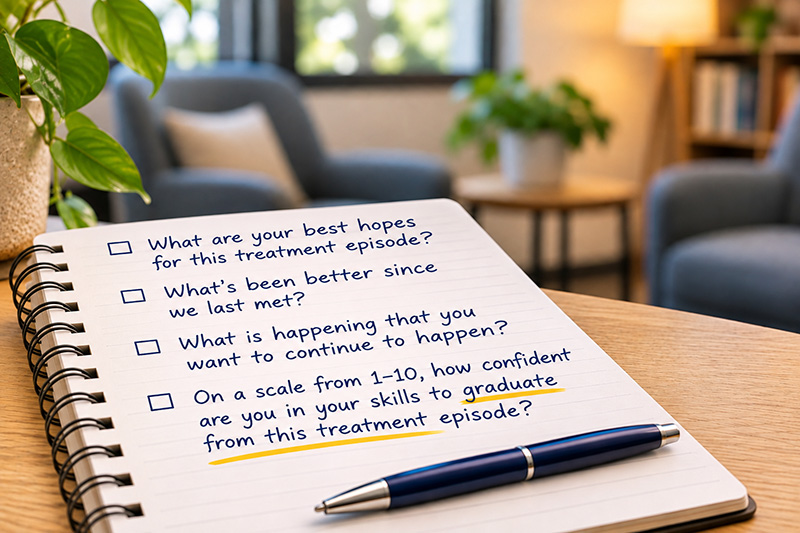
- What are your best hopes for this treatment episode?
- On a scale from 1 to 10, how well have you been coping with the challenges you’ve faced?
- When did you last notice things were a little better?
- What’s been better since we last met?
- What is happening that you want to continue to happen?
- On a scale from 1-10, with 10 being the best and 1 the opposite, how confident are you that you can keep yourself safe?
Each question gathers information a practitioner can use. The questions also serve a therapeutic purpose. A person who describes important relationships may become more aware of available support. Someone who identifies a time when things were better may recall what they did differently. Describing best hopes can help people begin to put their preferred future into words. Many clinical forms concentrate on symptoms, deficits, and risks. These do not tell the whole story. A person may be experiencing significant difficulties while also managing responsibilities, maintaining relationships, drawing on personal strengths, and making small improvements. Solution-focused questions allow practitioners to document these aspects of a person’s experience.
Assessing Readiness to Graduate From Treatment Episodes
Treatment reviews and discharge planning offer another opportunity to integrate assessment and intervention.
Consider asking:
On a scale from 1-10, where 10 is you are confident that your skills are good enough to graduate from this treatment episode and 1 is the opposite, where are you?
Follow-up questions might include:
- What keeps your number from being lower? What else?
- What is a good enough number?
- Who would notice your skills are good enough to graduate?
- What number would they give you?
- What accounts for the difference between or similarity of your numbers?
- If your number is good enough to graduate, what do you need to keep doing more of?
- If your number is not good enough to graduate, what is one small thing you could do to increase your number?
- How confident are you from 1-10 that you will do your best to increase your number?
The initial rating provides information about how prepared the person feels to complete treatment. The follow-up questions explore the reasons behind that rating. Asking what keeps the number from being lower brings existing skills and accomplishments into the conversation. Asking about a good-enough number helps the person identify what would make treatment completion reasonable from their perspective. Questions about what others might notice connect the rating to everyday behavior and relationships. The final questions address maintaining progress or taking a small step toward greater confidence.
Documentation as a Way to Develop Solution-Focused Fluency
Changing documentation may also help practitioners become more fluent in solution-focused language. Learning SFBT requires more than understanding its principles. Practitioners need experience asking about best hopes, positive differences, presuppositional questions, coping, VIPs, and solution-focused scaling. These questions often require deliberate practice, particularly for clinicians trained to begin with problems and symptoms.
Yet the forms practitioners complete every day may reinforce the very habits they are trying to change. An intake form that asks about best hopes gives the practitioner a reason to explore the person’s preferred future. A progress note that asks what has been better since we last met encourages the clinician to look for changes between sessions.
Repeated use may help practitioners become more fluent with solution-focused questions. Instead of treating them as techniques to remember during a session, clinicians encounter them throughout their ordinary work. Documentation then supports training rather than operating separately from it.
This possibility needs research. We cannot assume that changing forms will improve clinical skills or client outcomes. We can, however, examine whether practitioners use solution-focused questions more consistently when those questions are incorporated into routine documentation.
Working With the Documentation We Already Have
Practitioners already spend considerable time completing assessments and writing notes. I am not proposing that we add more paperwork. I am suggesting that we change some of the questions in the forms we already use.
An intake assessment could ask about best hopes for this treatment episode instead of what brought you here. A progress note could document improvements and coping efforts while detailing how they endured and coped with setbacks and challenges. A treatment plan could include the person’s description of what would be good enough to graduate from this treatment episode from 1-10.
By changing some questions in our documentation, we can make better use of the time we already spend assessing people—and give solution-focused conversations a place in the clinical record from the start.
For more related articles, check out: Solution-Focused Documentation, A Solution-Focused Safety Assessment Tool